The alien heals Newton
The HumansThe alien narrator’s healing of Newton turns a calculated attempt to win the dog’s cooperation into an act of care that the narrator finds difficult to explain away. By restoring Newton’s sight and healing his hind leg, the narrator relieves the animal’s pain but takes on a severe physical cost; the encounter also transforms their wary relationship into an almost overwhelming intimacy.
Need, Wariness, and the Decision to Heal
The narrator initially sees Newton as a potential ally during a short stay: the dog might have picked up information or heard signals. The narrator reasons that relieving someone’s pain is a reliable way to gain their support, but recognizes that this practical explanation conceals something more troubling. After feeling an urge to hurt, the narrator has also begun to feel an urge to heal—a change described as both difficult to acknowledge and dangerous.
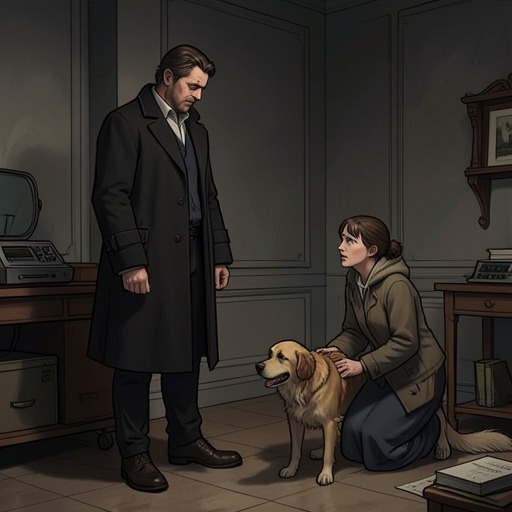
Newton has reason to distrust the narrator. He growls and bares his teeth, seemingly aware that the person before him is not quite who he should be. Yet his years of living under bipedal owners have taught him to grant a standing figure a degree of respect. The narrator approaches with a biscuit, using a small, familiar offering to bridge the distance before attempting the much greater intervention.
The Cure and Its Cost
After giving Newton the biscuit, the narrator gives him sight and strokes his hind leg while healing it. Newton whimpers words the narrator cannot translate. The recovery is not effortless: the narrator develops an even more intense headache and is overcome by waves of fatigue, then falls asleep on the kitchen floor. The cure thus reverses the direction of suffering without making the narrator invulnerable to its cost.
The narrator wakes coated in dog saliva, with Newton still licking enthusiastically. The repeated licking makes the dog’s affection a physical force rather than a calm sign of gratitude. Newton does not stop when asked; he is physically incapable of doing so until the narrator stands up. Even then, he tries to rise with the narrator and climb onto him, as though he too wants to be upright.
A Changed Bond
Before the healing, Newton’s growling made him a possible source of danger as well as information. Afterward, the problem is no longer how to earn his trust but how to manage its intensity. The narrator concludes that being loved by a dog can be worse than being hated by one, and regards dogs as exceptionally needy. The comic reversal registers a genuine change: a calculated attempt to secure an ally has produced an attachment the narrator cannot control, while the decision to heal reveals a capacity for care that conflicts with the earlier urge to hurt.